
Contents
Overview
The political contours of the Middle East are a palimpsest of empires, religious movements, and colonial redrawings. While the term "Middle East" itself is a relatively modern Western construct, dating from the early 20th century, the region's political consciousness is millennia-deep, rooted in the cradles of civilization like Mesopotamia and the Ancient Egyptian dynasties. The rise of Islam in the 7th century CE fundamentally reshaped political and social structures, leading to the caliphates and subsequent fragmentation. The decline of the Ottoman Empire after World War I proved a pivotal moment, as European powers like Britain and France carved out new states with artificial borders, sowing seeds of future conflict and nationalist aspirations. The discovery of vast oil reserves in the 20th century further cemented the region's global strategic importance, attracting external powers and fueling internal rivalries. The establishment of Israel in 1948 and the subsequent Arab-Israeli wars remain defining geopolitical fault lines.
⚙️ How It Works
Middle East politics operates through a complex interplay of state-centric governance, non-state actors, and transnational ideologies. Monarchies, such as in Saudi Arabia and Jordan, coexist with republics, some authoritarian and others with nominal democratic structures, like Iran and Turkey. The region is also characterized by powerful non-state actors, including groups like Hezbollah in Lebanon and the Houthi movement in Yemen, which wield significant political and military influence, often supported by regional powers like Iran and Saudi Arabia. International relations are dominated by a delicate balance of power, shifting alliances, and proxy conflicts, particularly between Saudi Arabia and Iran, often playing out in countries like Syria and Yemen. The United States and Russia remain significant external players, influencing regional security dynamics through military presence and diplomatic engagement.
📊 Key Facts & Numbers
The Middle East is home to approximately 5.8% of the world's population, with over 200 million people. The region controls an estimated 60% of the world's proven oil reserves, with Saudi Arabia alone holding around 15%. This resource wealth translates into significant economic power, with the GCC states collectively possessing trillions of dollars in sovereign wealth funds. However, political instability and conflict have had devastating economic consequences; the Syrian Civil War has reportedly cost upwards of $1.2 trillion in damages and lost economic output since 2011. Unemployment rates, particularly among youth, often exceed 25% in several countries, fueling social unrest. The region also faces significant water scarcity, with projections indicating that by 2050, demand could outstrip supply by 50% in some areas, posing a critical challenge to political stability and resource management.
👥 Key People & Organizations
Key figures and organizations have profoundly shaped Middle East politics. Leaders like Gamal Abdel Nasser of Egypt championed pan-Arabism in the mid-20th century, while Ayatollah Ruhollah Khomeini's 1979 revolution in Iran established a unique Islamic Republic. Contemporary figures such as Mohammed bin Salman, Crown Prince of Saudi Arabia, and Recep Tayyip Erdoğan, President of Turkey, are central to current regional dynamics. Major organizations include the GCC, an economic and political alliance of Arab states of the Persian Gulf, and the Arab League, a regional organization of Arab states. The United Nations plays a crucial role in mediating conflicts and providing humanitarian aid, often through agencies like UNRWA (United Nations Relief and Works Agency for Palestine Refugees in the Near East). The influence of religious institutions, such as Al-Azhar University in Cairo, also extends into the political sphere.
🌍 Cultural Impact & Influence
Middle East politics has a pervasive influence on global affairs, shaping international energy markets, driving geopolitical alliances, and influencing global security discourse. The region's cultural and religious significance, as the birthplace of Judaism, Christianity, and Islam, imbues its politics with a global resonance. The ongoing Israeli–Palestinian conflict remains a potent symbol of unresolved political grievances, frequently igniting broader regional tensions and influencing international diplomacy. The rise of ISIS and other extremist groups, though largely defeated territorially, has left a lasting impact on counter-terrorism strategies and international security cooperation. Furthermore, the region's diaspora populations in Europe and North America often engage with and influence the politics of their homelands, creating complex transnational political networks.
⚡ Current State & Latest Developments
The current geopolitical landscape of the Middle East is marked by several critical developments. The ongoing Abraham Accords, normalizing relations between Israel and several Arab nations, represent a significant shift in regional alignments, albeit with ongoing challenges regarding the Israeli–Palestinian conflict. Tensions between Iran and its regional rivals, particularly Saudi Arabia and Israel, continue to manifest through proxy conflicts in places like Syria and Yemen, with recent escalations involving direct confrontations. The political future of Afghanistan following the Taliban takeover in 2021 continues to be a source of regional and international concern. Economic diversification efforts are underway in many Gulf states, seeking to reduce reliance on oil revenues, as seen in Saudi Vision 2030. The aftermath of the 2023 Hamas-led attack on Israel and the subsequent Israeli military operations in Gaza have dramatically escalated regional tensions and humanitarian crises.
🤔 Controversies & Debates
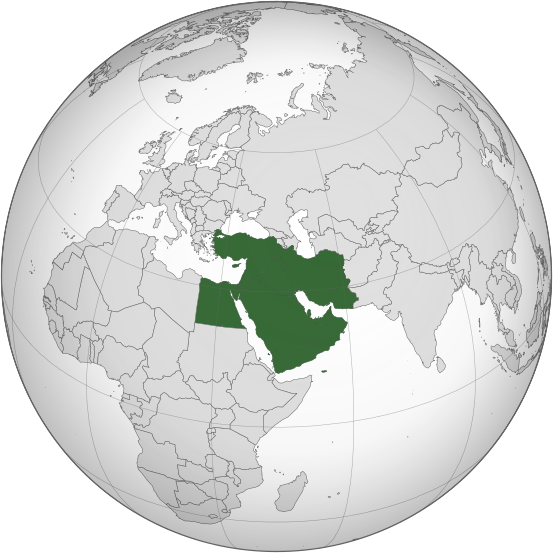
Middle East politics is rife with controversy. The legacy of colonial borders, drawn by external powers like Britain and France, is a persistent source of contention, with many arguing they do not reflect ethnic or sectarian realities, leading to ongoing territorial disputes and separatist movements, particularly among the Kurdish people. The role of external powers, from historical colonial mandates to contemporary interventions by the United States, Russia, and China, is a constant subject of debate, with accusations of neo-colonialism and interference in internal affairs. The application of Islamic law (Sharia) in governance, as seen in countries like Saudi Arabia and Iran, is another major point of contention, with varying interpretations and significant human rights concerns raised by international bodies. The definition and scope of the "Middle East" itself, often excluding or including countries like Egypt, Turkey, or Iran based on political expediency, remains a point of academic and political disagreement.
🔮 Future Outlook & Predictions
The future of Middle East politics is likely to be shaped by several key trends. The ongoing demographic shifts, with a large youth population in many countries, could lead to increased demands for political reform and economic opportunity, potentially fueling further instability or driving innovation. The transition away from fossil fuels, while a long-term prospect, will fundamentally alter the region's economic and geopolitical calculus, forcing diversification and potentially reducing the influence of petro-states. The resolution, or continued stagnation, of the Israeli–Palestinian conflict will remain a critical dete
Key Facts
- Category
- politics
- Type
- topic