
Contents
- 🌍 Origins & Historical Currents
- ⚙️ Key Players & Power Dynamics
- ⛽ Resource Control & Economic Levers
- 🤝 External Influence & Intervention
- 📜 Ideological & Religious Fault Lines
- 💥 Major Conflicts & Flashpoints
- 📈 Shifting Alliances & Regional Trends
- 🔮 Future Trajectories & Uncertainties
- 💡 Strategic Importance & Global Impact
- 📚 Further Reading & Related Concepts
- References
Overview
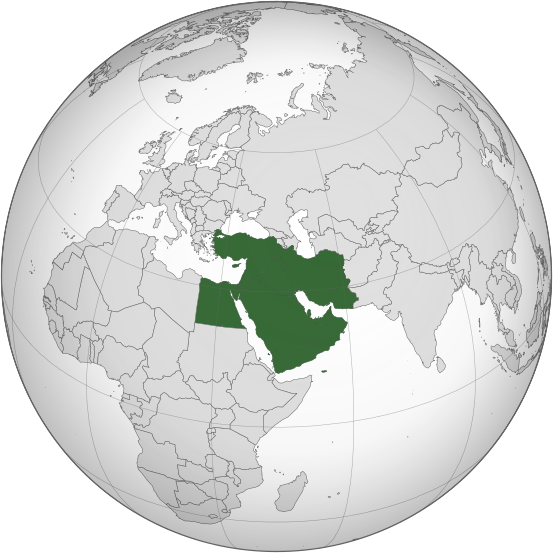
Middle East geopolitics refers to the intricate web of political, economic, and military relationships that define the region's power dynamics. This area, often loosely defined to include countries from Egypt to Iran and Turkey to Yemen, has been a crucible of civilizations and a flashpoint for global conflicts for centuries. Its strategic location, rich energy resources, and diverse religious and ethnic makeup contribute to its perpetual volatility. Key drivers include the historical legacy of empires like the Ottoman and Persian, the impact of colonial powers, the rise of nationalism, the enduring Israeli-Palestinian conflict, the pursuit of oil and gas dominance, and the ideological struggles between regional powers such as Saudi Arabia and Iran. Understanding Middle East geopolitics requires grappling with ancient rivalries, modern state-building challenges, and the constant interplay of internal forces and external interventions.
🌍 Origins & Historical Currents
The geopolitical landscape of the Middle East is a palimpsest of ancient empires and modern nation-states, each layer leaving indelible marks. The discovery of vast oil reserves in the early 20th century, particularly in Saudi Arabia and Iran, transformed the region into a global strategic prize, attracting the attention of powers like the United States and the Soviet Union during the Cold War. The establishment of Israel further intensified regional tensions, leading to a series of Arab-Israeli wars and a protracted conflict that continues to shape regional diplomacy.
⚙️ Key Players & Power Dynamics
At the heart of Middle East geopolitics are a handful of dominant state and non-state actors whose ambitions and rivalries dictate regional stability. Saudi Arabia, a major oil producer and custodian of Islam's holiest sites, often vies for influence with Iran, a Shia-majority republic with revolutionary aspirations. Turkey, under President Erdoğan, has increasingly asserted itself as a regional power, balancing its NATO commitments with its own strategic interests. Egypt, despite economic challenges, remains a significant Arab player. Meanwhile, non-state actors like Hezbollah in Lebanon and the Houthi movement in Yemen, often backed by Iran, exert considerable influence, complicating state-centric analyses. The United States has historically played a pivotal role, though its engagement has ebbed and flowed, creating vacuums and opportunities for other powers like Russia and China.
⛽ Resource Control & Economic Levers
The region's immense hydrocarbon wealth is arguably its most defining geopolitical feature. The Persian Gulf states, particularly Saudi Arabia, the UAE, and Qatar, control a significant portion of the world's proven oil and gas reserves. This endowment has funded massive development projects, supported extensive welfare states, and made these nations crucial to global energy security. However, it has also made them targets for external influence and internal dissent, fueling proxy conflicts and contributing to the 'resource curse' phenomenon. The ongoing global transition towards renewable energy poses a long-term challenge to the economic and geopolitical dominance of these petrostates, forcing them to diversify their economies through initiatives like Saudi Arabia's Vision 2030.
🤝 External Influence & Intervention
External powers have long been drawn to the Middle East, seeking to secure energy supplies, project influence, and manage regional conflicts. The legacy of British and French colonialism in the 20th century laid the groundwork for many of the region's modern borders and political structures. The Soviet Union also exerted influence, particularly in Syria and Iraq. More recently, Russia has reasserted its presence, notably through its intervention in the Syrian Civil War, while China has steadily increased its economic footprint, particularly through energy imports and infrastructure investments via the Belt and Road Initiative.
📜 Ideological & Religious Fault Lines
The Middle East is a mosaic of religious and ethnic groups, and sectarian and ideological divides have been consistently exploited and amplified to serve geopolitical ends. The historical schism between Sunni and Shia Islam, exacerbated by the rivalry between Saudi Arabia and Iran, fuels conflicts in countries like Yemen and Syria. The rise of political Islam, encompassing movements from the Muslim Brotherhood to ISIS, has also profoundly shaped regional politics, challenging secular regimes and traditional monarchies. The enduring Israeli-Palestinian conflict remains a potent symbol of unresolved national and religious grievances, often serving as a rallying point for broader regional discontent.
💥 Major Conflicts & Flashpoints
The Middle East has been a persistent theater of conflict, ranging from interstate wars to protracted insurgencies and proxy battles. The Arab-Israeli wars of the 20th century, including the Six-Day War (1967) and the Yom Kippur War (1973), fundamentally altered the region's political map. More recently, the 1990 invasion of Kuwait by Saddam Hussein's Iraq led to the First Gulf War. The 2003 invasion of Iraq destabilized the country, contributing to the rise of sectarian violence and the emergence of groups like ISIS. The ongoing Syrian Civil War, which began in 2011, has become a complex proxy war involving multiple regional and international powers, while the conflict in Yemen pits a Saudi-led coalition against Iran-backed Houthi rebels.
📈 Shifting Alliances & Regional Trends
In recent years, the geopolitical landscape of the Middle East has been characterized by shifting alliances and evolving dynamics. The Abraham Accords, brokered by the United States, saw several Arab nations normalize relations with Israel, signaling a potential realignment away from traditional Arab solidarity and towards shared concerns about Iran. Meanwhile, Saudi Arabia and Iran have engaged in diplomatic overtures, including a China-brokered deal to restore ties in 2023, suggesting a potential de-escalation of their proxy conflicts. Turkey continues to navigate a complex path, engaging in both cooperation and competition with various regional actors. The role of the United States as a security guarantor is also under scrutiny, prompting regional states to enhance their own defense capabilities and seek new partnerships.
🔮 Future Trajectories & Uncertainties
The future of Middle East geopolitics remains highly uncertain, influenced by a confluence of factors including demographic shifts, economic diversification efforts, and the ongoing global energy transition. The potential for renewed conflict, particularly between Iran and its adversaries, remains a significant concern, especially in light of Iran's nuclear program. The long-term stability of oil-dependent economies hinges on their ability to successfully diversify and adapt to a post-fossil fuel world. Furthermore, the resolution of protracted conflicts, such as the Israeli-Palestinian conflict, will continue to be a critical determinant of regional peace. The increasing assertiveness of regional powers and the evolving role of external actors like China and Russia will also shape the geopolitical contours of the coming decades.
💡 Strategic Importance & Global Impact
The Middle East's geopolitical significance extends far beyond its borders, impacting global energy markets, international security, and religious and cultural discourse. Its strategic location, bridging Africa, Asia, and Europe, has made it a historical crossroads for trade and conquest. The region's vast oil and gas reserves continue to influence global economic stability, with fluctuations in supply and price having ripple effects worldwide. The ongoing conflicts and political instability have led to significant refugee crises, impacting neighboring countries and prompting international humanitarian responses. Moreover, the region's deep religious and cultural heritage, encompassing Judaism, Christianity, and Islam, makes its political
Key Facts
- Category
- geopolitics
- Type
- topic